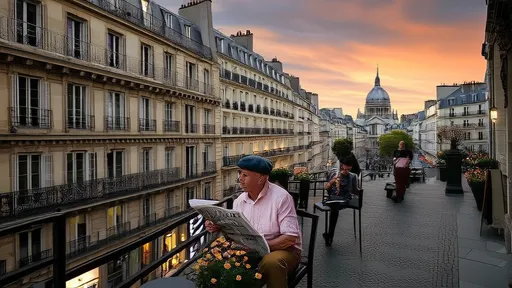
The Paris Olympics have come and gone, leaving behind a city buzzing with renewed energy. While the Eiffel Tower and Louvre will always draw crowds, a quieter Paris is emerging in the aftermath—one where hidden neighborhoods offer a more intimate, authentic experience. For travelers seeking to avoid the well-trodden paths, these lesser-known districts provide a glimpse into the soul of the city beyond the postcard landmarks.
The Marais' Secret Sibling: Haut Marais
Just north of the tourist-heavy Marais lies Haut Marais, a district that has quietly evolved into one of Paris' most compelling neighborhoods. Where the southern Marais overflows with souvenir shops, Haut Marais retains its residential charm while housing some of the city's most innovative concept stores and galleries. The narrow streets around Rue de Poitou reveal designer ateliers working behind unmarked doors, while the Marché des Enfants Rouges—Paris' oldest covered market—bustles with locals buying organic produce and Moroccan tagines. This is where Parisians come to escape the crowds while still enjoying exceptional food and shopping.
Belleville: Where Paris Rediscovers Its Edge
Far from the Haussmannian uniformity of central Paris, Belleville's steep streets tell a different story. This multicultural neighborhood has become a canvas for street artists, with murals transforming entire building facades into breathtaking works of art. The Parc de Belleville offers what might be the city's most spectacular panoramic view—sweeping from the Sacré-Cœur to the Montparnasse Tower without the tourist hordes of Montmartre. At night, tiny wine bars and independent music venues pulse with energy, offering a taste of Paris' underground creative scene that most visitors never experience.
The Canal Saint-Martin Renaissance
Once a industrial waterway, the Canal Saint-Martin has blossomed into the heart of Paris' bobo (bourgeois-bohemian) culture. The iron footbridges and locks create picturesque scenes, but the real magic happens along the quays where locals picnic with bottles of natural wine as the sun sets. Boutique hotels have moved into converted warehouses, while innovative restaurants serve inventive takes on French classics. On Sundays when the roads close to traffic, the area becomes a pedestrian's paradise of flea markets and pop-up performances.
Butte-aux-Cailles: Paris' Village Within a City
Tucked away in the 13th arrondissement, Butte-aux-Cailles feels like a provincial town accidentally transported to the capital. Cobblestone streets wind past pastel-colored houses and art nouveau fountains, with nary a chain store in sight. The area maintains its working-class roots while attracting a young, artistic crowd drawn to its affordable studios and vibrant street art scene. Thermal springs beneath the neighborhood feed the Art Deco swimming pool, offering a bathing experience far removed from the crowded tourist baths elsewhere in the city.
Batignolles: The New Parisian Dream
What Notting Hill is to London, Batignolles is becoming to Paris—a picturesque enclave where young families and creatives are putting down roots. The sprawling Parc Martin Luther King represents a new vision of urban green space, with wildflower meadows and sustainable design. Organic bakeries and specialty coffee shops line the village-like square, while the old railway arches now house microbreweries and cheese affineurs. This is contemporary Parisian life at its most appealing, far from the museum ticket lines and overpriced cafés of the center.
Aligre: Where Paris Shops Like It's 1950
The Marché d'Aligre remains one of Paris' last truly local markets, where third-generation vendors hawk everything from vintage copper pots to exotic spices. The covered Beauvau market offers pristine seafood and rare cheeses, while the outdoor stalls sell imperfect produce at prices that haven't existed elsewhere in Paris for decades. Surrounding streets reveal hidden wine bars and family-run bistros that have resisted gentrification. For travelers craving an authentic slice of Parisian daily life, Aligre delivers without self-conscious nostalgia.
The New Face of La Défense
Paris' modern business district has quietly developed a cultural life beyond its skyscrapers. The recently opened Coulée Verte—a elevated park inspired by New York's High Line—winds between architectural landmarks, offering stunning views back toward central Paris. Unexpected art installations appear in corporate plazas, while rooftop bars provide cocktail experiences with unparalleled vistas. As offices empty on weekends, a different crowd arrives to explore the area's growing collection of contemporary galleries and design shops.
These neighborhoods represent Paris' ongoing evolution—a city constantly rediscovering itself beyond the monuments. In the wake of the Olympics, as the crowds disperse from major sites, these districts offer travelers the chance to experience Paris not as spectators, but as temporary residents participating in the city's daily rhythm. From the creative energy of Belleville to the village charm of Butte-aux-Cailles, they prove that Paris' greatest magic often lies where the guidebooks don't point.
By /Aug 5, 2025
By /Aug 5, 2025

By /Aug 5, 2025
By /Aug 5, 2025

By /Aug 5, 2025
By /Aug 5, 2025
By /Aug 5, 2025
By /Aug 5, 2025
By /Aug 5, 2025
By /Aug 4, 2025

By /Aug 4, 2025

By /Aug 4, 2025
By /Aug 4, 2025

By /Aug 4, 2025
By /Aug 4, 2025

By /Aug 4, 2025

By /Aug 4, 2025
By /Aug 4, 2025

By /Aug 4, 2025

By /Aug 4, 2025